Control Surface Modeling and Control Authority Analysis for Longitudinal Motion of Control-Configured Vehicle
Published in Korean (English title shown)
2021 KSAS Fall Conference (KSAS 2021F), Jeju, Korea, Nov. 2021
Figures and captions reproduced from the paper (© the authors and original publisher).
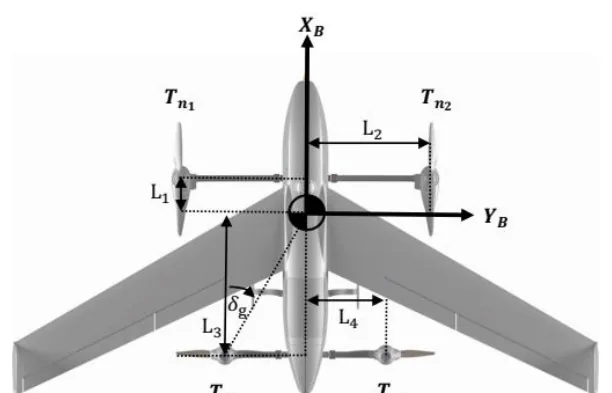
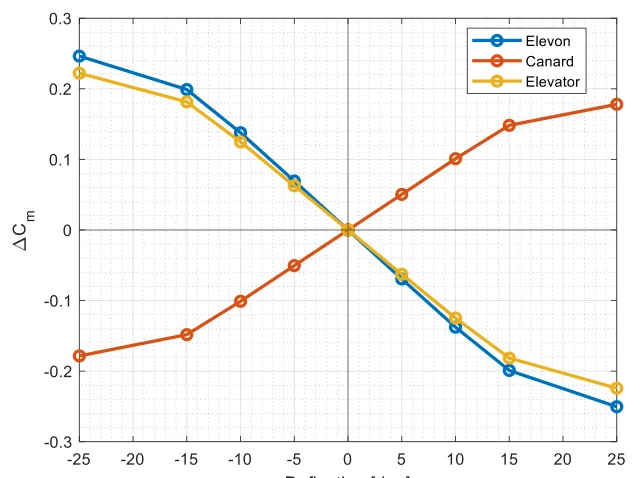
Current ground-based explosive ordnance clearance methods are inefficient in terms of time and cost, increasing the need for wide-area detection systems using unmanned aerial vehicles. Detecting buried explosives with UAV-mounted sensors constrains UAV maneuvers according to sensor characteristics. To perform the mission under these constraints, additional control surfaces and a flight-control system that accounts for them are required to improve control authority. This study considers additional control effectors to improve the longitudinal flight performance of the existing ARGOS-1 vehicle and compares them with the baseline configuration. Specifically, it considers using the forward propulsors, which are inactive in fixed-wing mode, installing canards at the front of the vehicle, and installing an elevator at the rear; trim analysis is used to evaluate the resulting changes in control authority.
https://www.dbpia.co.kr/journal/articleDetail?nodeId=NODE11031427BibTeX@inproceedings{Lee2021,
title = {Control Surface Modeling and Control Authority Analysis for Longitudinal Motion of Control-Configured Vehicle},
author = {Jihoon Lee and Hyeonggwan Kang and Sangmin Lee and Youdan Kim and Jinyoung Suk and Seungkeun Kim},
year = {2021},
booktitle = {2021 KSAS Fall Conference (KSAS 2021F), Jeju, Korea, Nov. 2021},
note = {Original Korean title: 능동제어 비행체의 종방향 운동을 위한 조종면 모델링 및 조종력 분석},
}