Publications
43 publications total · a unified list combining Google Scholar records with additional entries. Also available on my Google Scholar profile.
Publication insights
Year, venues, citations, and research focus
Publications by Year
Table view
| Year | Int'l Journal | Domestic Journal | Int'l Conference | Domestic Conference | Ph.D. Dissertation |
|---|---|---|---|---|---|
| 2015 | 0 | 0 | 2 | 1 | 0 |
| 2016 | 0 | 0 | 0 | 3 | 0 |
| 2017 | 0 | 0 | 1 | 6 | 0 |
| 2018 | 0 | 0 | 3 | 4 | 0 |
| 2019 | 1 | 0 | 4 | 3 | 0 |
| 2020 | 1 | 0 | 1 | 1 | 0 |
| 2021 | 1 | 0 | 3 | 2 | 0 |
| 2022 | 1 | 0 | 0 | 0 | 0 |
| 2023 | 2 | 0 | 0 | 0 | 1 |
| 2024 | 1 | 1 | 0 | 0 | 0 |
Publication Venues
Journal titles and recurring conference series are grouped across years.
Int'l Journal
7 publications · 5 venues- IEEE Access 2
- IEEE Transactions on Aerospace and Electronic Systems 2
- International Journal of Aeronautical and Space Sciences 1
- Proceedings of the Institution of Mechanical Engineers, Part G: Journal of Aerospace Engineering 1
- Sensors 1
Domestic Journal
1 publication · 1 venue- Journal of the Korean Society for Aeronautical & Space Sciences 1
Int'l Conference
14 publications · 7 venues- APISAT 5
- AIAA SciTech Forum 2
- EUCASS 2
- ICAS Congress 2
- European Control Conference (ECC) 1
- ICCAS 1
- IFAC Symposium on Automatic Control in Aerospace (ACA) 1
Domestic Conference
20 publications · 4 venues- KSAS Conference 17
- Aviation-Specialized University Conference 1
- IPNT Conference 1
- SASE Conference 1
Ph.D. Dissertation
1 publication · 1 venue- Seoul National University 1
Citations by Year
Source: Google Scholar · 2018–2026 · updated Nov. 2026
Table view
| Year | Citations |
|---|---|
| 2018 | 1 |
| 2019 | 8 |
| 2020 | 9 |
| 2021 | 9 |
| 2022 | 33 |
| 2023 | 29 |
| 2024 | 44 |
| 2025 | 55 |
| 2026 | 50 |
Google Scholar Index
Source: Google Scholar · updated Nov. 2026
| All | Since 2021 | |
|---|---|---|
| Citations | 239 | 220 |
| h-index | 9 | 8 |
| i10-index | 6 | 6 |
Research & Engineering Focus
Publication language with curated professional focus areas; size shows weighted prominence.
Table view
| Keyword | Weighted score |
|---|---|
| control | 153 |
| morphing | 142 |
| Semiconductor AI | 138 |
| Machine Learning | 124 |
| Engineering Software | 116 |
| Aerospace GNC | 112 |
| aircraft | 108 |
| UAV Guidance & Control | 108 |
| Optimization | 106 |
| Morphing Aircraft | 104 |
| Industrial AI | 84 |
| Autonomous Systems | 78 |
| uav | 57 |
| flight | 37 |
| landing | 34 |
| variable-span | 32 |
| nonlinear | 28 |
| carrier | 27 |
| performance | 27 |
| path | 27 |
| detection | 27 |
| dynamic | 26 |
| linear | 26 |
| neural | 25 |
| simulation | 25 |
| wing | 25 |
| asymmetric | 24 |
| controller | 23 |
| phase | 18 |
| vehicle | 17 |
| tracking | 17 |
| planning | 16 |
| longitudinal | 16 |
| mine | 16 |
| lpv | 15 |
| optimal | 15 |
| span | 15 |
| altitude | 15 |
| automatic | 14 |
| adaptive | 14 |
| parameter-varying | 14 |
| network | 14 |
| allocation | 14 |
| risk | 14 |
| decision | 14 |
| unmanned | 13 |
| aerial | 13 |
| inversion | 13 |
| variable | 13 |
| parameters | 13 |
| guidance | 12 |
| configuration | 12 |
| indoor | 12 |
| maneuver | 11 |
| target | 11 |
| pitch-hold | 11 |
| programming | 11 |
| making | 11 |
| attitude | 10 |
| network-based | 10 |
| rescue | 10 |
| operations | 10 |
| motion | 10 |
| characteristics | 10 |
International Journal Articles (7)
-
IEEE Transactions on Aerospace and Electronic Systems, Vol. 60, No. 5, pp. 6447-6460, 2024 · 12 citations
Abstract
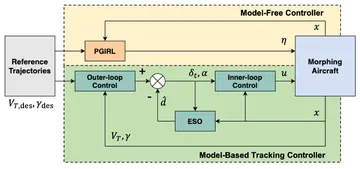
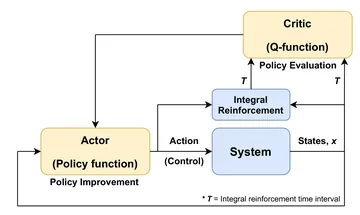
A control design scheme that integrates policy-gradient-based integral reinforcement learning with an extended state observer is proposed for a morphing aircraft. A general continuous-time nonaffine system, such as a morphing aircraft, in which the morphing parameters are considered as control effectors, can be addressed by the proposed control scheme. By combining a Q-function with the policy gradient method, the optimal control problems for completely unknown and nonaffine systems can be resolved. The actor-critic parameter estimation employs the integral reinforcement learning technique. The learning-based strategy enables the prediction of optimal morphing parameters, even in the absence of a complete aerodynamic model. To estimate the disturbances derived from morphing variations, an extended state observer is designed using the knowledge of the nominal model. This approach allows for the independent design of controllers for both morphing parameters and conventional control effectors. A stability analysis shows the asymptotic stability of the closed-loop system and the optimal convergence of the Q-function. To demonstrate the effectiveness of the proposed method, a numerical simulation is performed.
IEEE Xplorehttps://ieeexplore.ieee.org/document/10535708/DOI: 10.1109/TAES.2024.3403543https://doi.org/10.1109/TAES.2024.3403543BibTeX@article{Lee2024, title = {Control Design Using Policy-Gradient-Based Integral Reinforcement Learning and Extended State Observer for Morphing Aircraft}, author = {Hanna Lee and Seong-hun Kim and Jihoon Lee and Youdan Kim}, year = {2024}, journal = {IEEE Transactions on Aerospace and Electronic Systems}, volume = {60}, number = {5}, pages = {6447-6460}, doi = {10.1109/TAES.2024.3403543}, } -
IEEE Access, Vol. 11, pp. 40930-40943, 2023 · 19 citations
Abstract
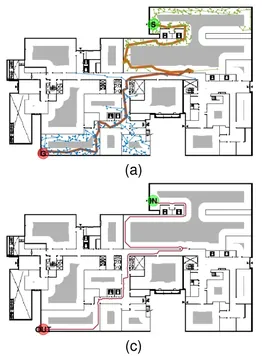
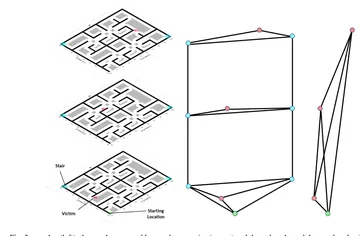
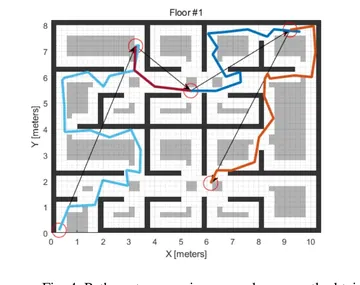
In this study, a multi-level path planning system is proposed for indoor search and rescue operations. Requirements for the path planning system are derived based on the operational concept of the integrated indoor navigation system. Different aspects of various path planning algorithms are assessed, and their suitability to search and rescue operations in structured indoor environments is investigated. A five-step path planning system is proposed, which consists of map pre-processing, segment path planning, graph processing, route optimization, and path post-processing. The proposed method addresses a multi-goal path planning problem in a multi-story building in a computationally efficient way by adopting a graph-based approach while satisfying such requirements as clearance conditions in the pre- and post-processing steps. Furthermore, a multi-query approach is adopted to exploit the response time and earn flexibility with respect to environmental changes. The effectiveness of the proposed path planning system is demonstrated through numerical simulations. The proposed multi-level path planning system successfully adapts to complex indoor environments, enabling more effective navigation for search and rescue operations. Additionally, the system exhibits a high degree of flexibility in response to environmental changes, ensuring that the path planning remains robust and reliable even in dynamically changing situations.
IEEE Xplorehttps://ieeexplore.ieee.org/document/10107604/DOI: 10.1109/ACCESS.2023.3269981https://doi.org/10.1109/ACCESS.2023.3269981BibTeX@article{Lee2023, title = {Multi-level indoor path planning and clearance-based path optimization for search and rescue operations}, author = {Jihoon Lee and Heein Park and Youdan Kim and Chan Gook Park and Jae Hong Lee}, year = {2023}, journal = {IEEE Access}, volume = {11}, pages = {40930-40943}, doi = {10.1109/ACCESS.2023.3269981}, } -
Sensors, Vol. 23, No. 6, 3075, 2023 · 9 citations
Abstract
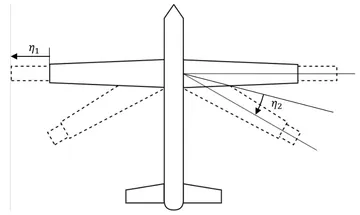
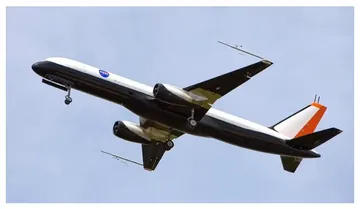
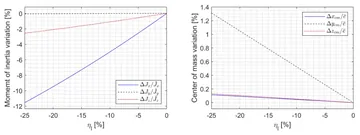
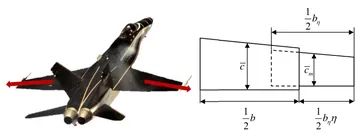
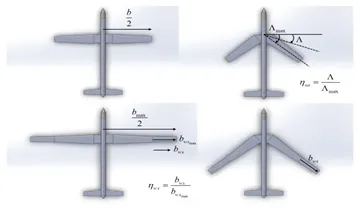
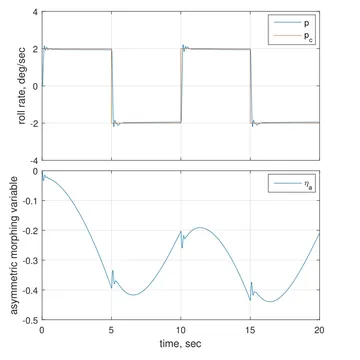
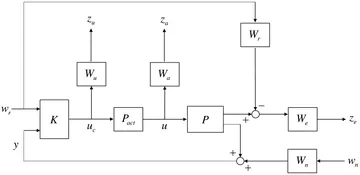
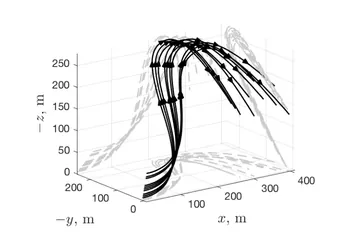
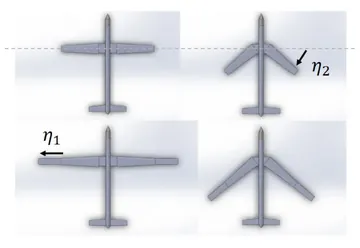
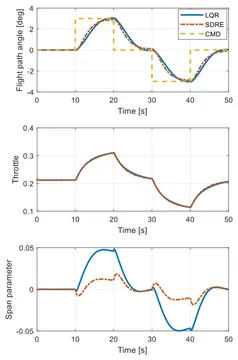
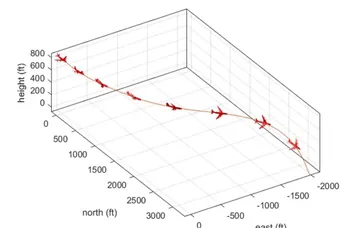
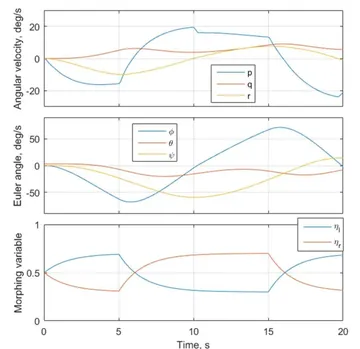
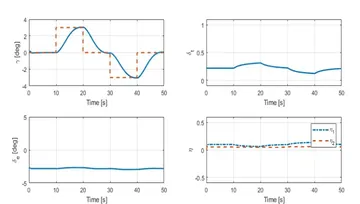
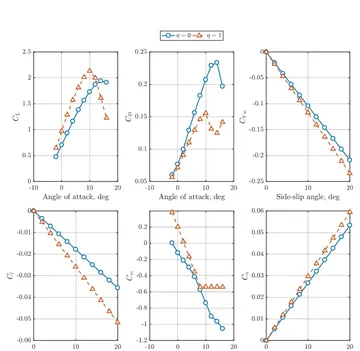
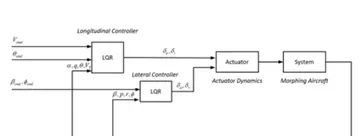
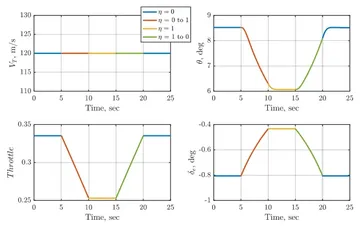
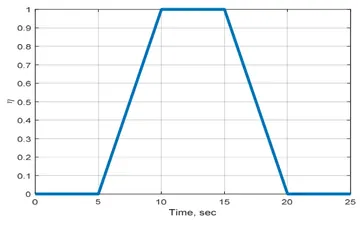
In this study, a novel framework for the flight control of a morphing unmanned aerial vehicle (UAV) based on linear parameter-varying (LPV) methods is proposed. A high-fidelity nonlinear model and LPV model of an asymmetric variable-span morphing UAV were obtained using the NASA generic transport model. The left and right wing span variation ratios were decomposed into symmetric and asymmetric morphing parameters, which were then used as the scheduling parameter and the control input, respectively. LPV-based control augmentation systems were designed to track the normal acceleration, angle of sideslip, and roll rate commands. The span morphing strategy was investigated considering the effects of morphing on various factors to aid the intended maneuver. Autopilots were designed using LPV methods to track commands for airspeed, altitude, angle of sideslip, and roll angle. A nonlinear guidance law was coupled with the autopilots for three-dimensional trajectory tracking. A numerical simulation was performed to demonstrate the effectiveness of the proposed scheme.
MDPIhttps://www.mdpi.com/1424-8220/23/6/3075DOI: 10.3390/s23063075https://doi.org/10.3390/s23063075BibTeX@article{Lee2023, title = {Self-scheduled LPV control of asymmetric variable-span morphing UAV}, author = {Jihoon Lee and Seong-hun Kim and Hanna Lee and Youdan Kim}, year = {2023}, journal = {Sensors}, volume = {23}, number = {6}, pages = {3075}, doi = {10.3390/s23063075}, } -
International Journal of Aeronautical and Space Sciences, Vol. 23, pp. 746-754, 2022 · 6 citations
Abstract
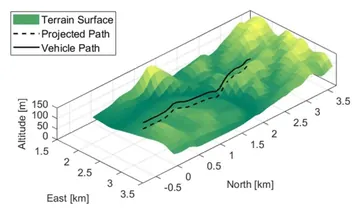
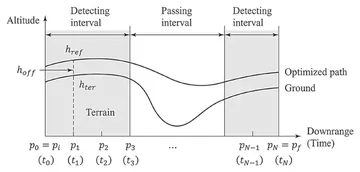
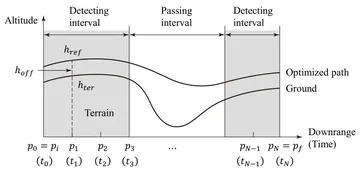
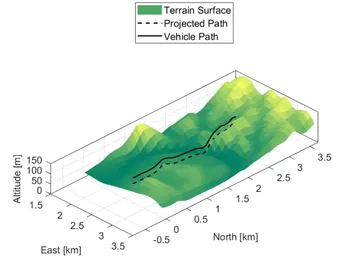
An optimization problem is formulated to maximize the coverage of the detection area for a fixed wing unmanned aerial vehicle (UAV), which performs a landmine detection mission. The UAV has mine detection devices including magnetic field sensors and chemical sensors. Due to the characteristics of the detection sensors, the UAV should fly at a certain altitude above the ground while following the terrain to perform accurate mine detection. Also, the UAV is required to maintain the pitch angle around the trim value when changing the altitude. Consequently, the altitude change rate of the UAV is limited during the mission. To maximize the mine detection capability within the limit, in this study, the entire flight interval is divided into the intervals on which the mines can be detected accurately and the intervals on which accurate detection is not possible. Logical variables are introduced to indicate the satisfaction of the requirements for accurate detection. Constraints on the logical variables are transformed into a set of linear inequalities containing continuous variables and binary integer variables. Finally, the optimization problem is formulated as a mixed-integer linear programming problem. The effectiveness of the proposed method is demonstrated through numerical simulation.
SpringerLinkhttps://link.springer.com/article/10.1007/s42405-022-00454-7DOI: 10.1007/s42405-022-00454-7https://doi.org/10.1007/s42405-022-00454-7BibTeX@article{Lee2022, title = {Optimal policy of pitch-hold phase for mine detection of UAV based on mixed-integer linear programming}, author = {Sangmin Lee and Hyeonggwan Kang and Jihoon Lee and Youdan Kim}, year = {2022}, journal = {International Journal of Aeronautical and Space Sciences}, volume = {23}, pages = {746-754}, doi = {10.1007/s42405-022-00454-7}, } -
IEEE Access, Vol. 9, pp. 30993-31009, 2021 · 9 citations
Abstract
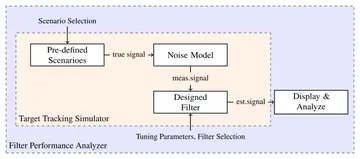
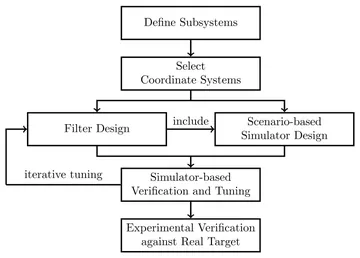
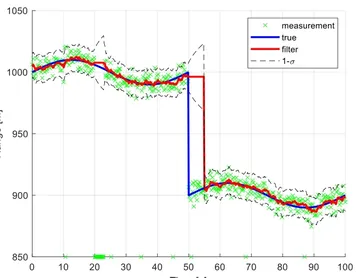
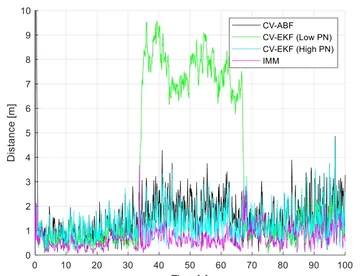
A target tracking system with a laser rangefinder is developed, and the performance of the developed system is verified by a numerical simulation and field tests. To develop the target tracking system, appropriate coordinate systems, motion models, and estimation methods are selected, and a range filter is designed to compensate for the measurement errors of the laser rangefinder. The range filter independently processes the range measurements so that the target filter continuously produces the target information. The entire target tracking system development process is described in detail to facilitate future work of a similar nature. A scenario-based Monte Carlo simulation is performed to compare the performances of various state estimation methods. Experimental tests involving a low-speed fishing boat and a drone are performed to verify the performance and effectiveness of the proposed scheme. A separate performance analysis program with a graphical user interface is developed to analyze the simulation and field test results.
IEEE Xplorehttps://ieeexplore.ieee.org/document/9356604/Author PDFhttps://jihoonlee91.github.io/papers/pdfs/2021-target-tracking-laser-rangefinder.pdfDOI: 10.1109/ACCESS.2021.3060061https://doi.org/10.1109/ACCESS.2021.3060061BibTeX@article{Lee2021, title = {Performance verification of a target tracking system with a laser rangefinder}, author = {Jihoon Lee and Suwon Lee and Youngjun Lee and Youdan Kim and Yongjun Heo and Taedong Yoon}, year = {2021}, journal = {IEEE Access}, volume = {9}, pages = {30993-31009}, doi = {10.1109/ACCESS.2021.3060061}, } -
Proceedings of the Institution of Mechanical Engineers, Part G: Journal of Aerospace Engineering, Vol. 234, No. 10, pp. 1624-1637, 2020 · 30 citations
Abstract
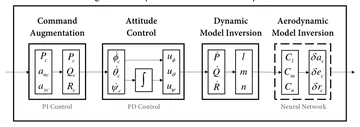
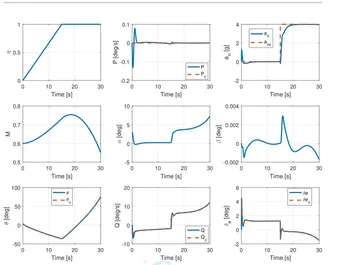
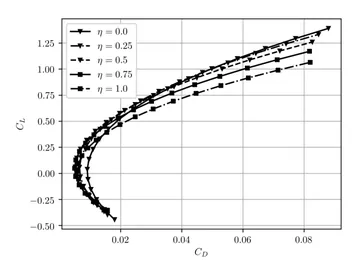
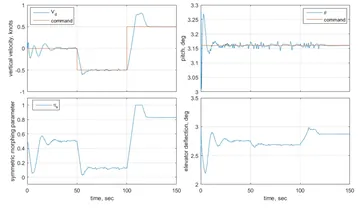
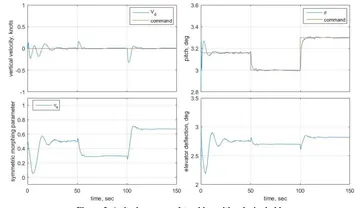
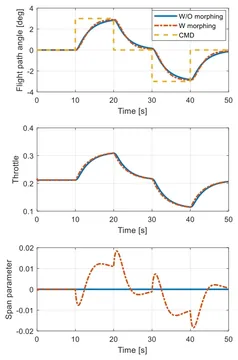
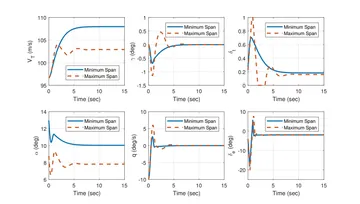
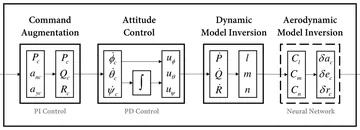
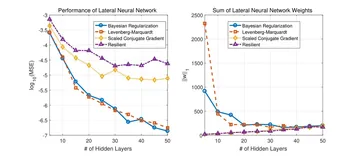
A nonlinear command and stability augmentation system is designed based on feedback linearization for a morphing aircraft in the presence of different variable-span configurations. A variable-span morphing aircraft model is obtained by modifying a conventional aircraft model. Feed-forward neural networks are trained to learn the inverse dynamics in various morphing configurations and flight conditions. An attitude orientation system is designed to stabilize the airframe and track the commanded angular rates. Finally, an online adaptive mechanism is employed to compensate for inversion error. Even when the aircraft is changing the morphing configuration while maneuvering, the proposed design satisfies the desired handling quality specifications. Consequentially, the proposed design provides another degree of freedom to manipulate the morphing configuration, and therefore agility or fuel efficiency can be improved. Numerical simulation is performed to demonstrate the effectiveness of the proposed scheme.
SAGE Journalshttps://journals.sagepub.com/doi/10.1177/0954410019846713DOI: 10.1177/0954410019846713https://doi.org/10.1177/0954410019846713BibTeX@article{Lee2020, title = {Neural network-based nonlinear dynamic inversion control of variable-span morphing aircraft}, author = {Jihoon Lee and Youdan Kim}, year = {2020}, journal = {Proceedings of the Institution of Mechanical Engineers, Part G: Journal of Aerospace Engineering}, volume = {234}, number = {10}, pages = {1624-1637}, doi = {10.1177/0954410019846713}, } -
IEEE Transactions on Aerospace and Electronic Systems, Vol. 55, No. 2, pp. 951-966, 2019 · 87 citations
Abstract
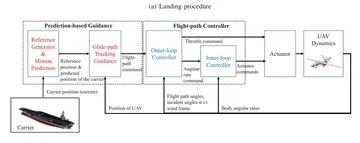
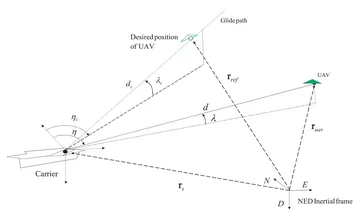
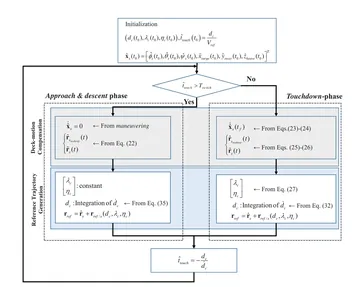
A guidance and control system is proposed for automatic carrier landing of an unmanned aerial vehicle (UAV). To this end, the position and attitude of the carrier is predicted by considering the sea state so that the UAV guidance loop can be compensated during the final approach phase. The landing kinematics and reference trajectory are determined using the predicted touchdown position. Nonlinear guidance and control laws are designed based on a sliding-mode control scheme to make the UAV robustly follow the reference trajectory.
IEEE Xplorehttps://ieeexplore.ieee.org/document/8447257/DOI: 10.1109/TAES.2018.2867259https://doi.org/10.1109/TAES.2018.2867259BibTeX@article{Lee2019, title = {Sliding mode guidance and control for UAV carrier landing}, author = {Seokwon Lee and Jihoon Lee and Somang Lee and Hyunjin Choi and Youdan Kim and Seungkeun Kim and Jinyoung Suk}, year = {2019}, journal = {IEEE Transactions on Aerospace and Electronic Systems}, volume = {55}, number = {2}, pages = {951-966}, doi = {10.1109/TAES.2018.2867259}, }

Domestic Journal Articles (1)
-
Journal of the Korean Society for Aeronautical & Space Sciences, Vol. 52, No. 4, pp. 297-306, 2024 · in Korean
Abstract
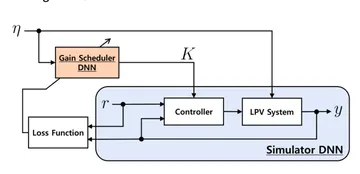
A methodology is presented in this study for the automated gain scheduling of multiple linear systems utilizing deep neural networks. The focus is on a morphing aircraft's short-period dynamic motion and the application of a PID controller. The morphing aircraft dynamics system can be effectively modeled as a linear parameter-varying system in relation to the morphing parameters. As the morphing parameters change, different linear systems are considered. To address this, a deep neural network structure is employed, integrating an LPV system dynamics simulator. The gain scheduler neural network is trained to optimize the unit step response, enabling it to output control gains based on the morphing parameters. A performance comparison is conducted between the scheduler trained using the proposed methodology and a manually-tuned scheduler.
DBpiahttps://www.dbpia.co.kr/journal/articleDetail?nodeId=NODE11763229DOI: 10.5139/jksas.2024.52.4.297https://doi.org/10.5139/jksas.2024.52.4.297BibTeX@article{Lee2024, title = {Gain Scheduling Using Deep Neural Network for Morphing Aircraft}, author = {Jihoon Lee and Suwon Lee and Euichan Yoon}, year = {2024}, journal = {Journal of the Korean Society for Aeronautical & Space Sciences}, volume = {52}, number = {4}, pages = {297-306}, doi = {10.5139/jksas.2024.52.4.297}, note = {Original Korean title: 모핑항공기의 심층신경망 기반 게인스케줄링 연구}, }
International Conference Papers (14)
-
21st International Conference on Control, Automation and Systems (ICCAS), Jeju, Korea, Oct. 2021 · 8 citations
Abstract
A longitudinal altitude and attitude controller is designed for an unmanned aerial vehicle to detect landmines. The UAV considered in this study has two front rotors, two rear rotors, and elevons. Due to the characteristics of the mine detection sensor, the allowable pitch change of the UAV is strictly limited. Therefore, the attitude controller considering the pitch-hold constraint should be designed. To deal with a flight path angle change limit due to the pitch-hold constraint and accurate altitude tracking, a linear model predictive control method is used for altitude control design. Numerical simulation is carried out to demonstrate the performance of the proposed controller.
IEEE Xplorehttps://ieeexplore.ieee.org/document/9649884/DOI: 10.23919/ICCAS52745.2021.9649884https://doi.org/10.23919/ICCAS52745.2021.9649884BibTeX@inproceedings{Kang2021, title = {Altitude tracking of UAV with pitch-hold constraint based on model predictive control for mine detection}, author = {Hyeonggwan Kang and Sangmin Lee and Jihoon Lee and Youdan Kim and Jinyoung Suk and Seungkeun Kim}, year = {2021}, booktitle = {21st International Conference on Control, Automation and Systems (ICCAS), Jeju, Korea, Oct. 2021}, doi = {10.23919/ICCAS52745.2021.9649884}, } -
32nd Congress of the International Council of the Aeronautical Sciences (ICAS), Shanghai, China, Sep. 2021 · 1 citations
Abstract
In this study, a flight control system is designed for an asymmetric variable-span morphing aircraft. The generic transport model is used to obtain a morphing aircraft model by incorporating the damage information. The integrated flight control system is designed based on nonlinear dynamic inversion and time-scale separation. It is shown that asymmetric span morphing can be used for roll control, while symmetric morphing can be used to either optimize flight performance or directly control aerodynamic forces. Numerical simulation results demonstrate the effectiveness of the proposed scheme.
ICAS Archivehttps://icas.org/ICAS_ARCHIVE/ICAS2020/data/papers/ICAS2020_0959_paper.pdfBibTeX@inproceedings{Lee2021, title = {Aircraft Autopilot Design Using Asymmetric Variable-Span Wing Morphing}, author = {Jihoon Lee and Seong-hun Kim and Seungyun Jung and Hanna Lee and Youdan Kim}, year = {2021}, booktitle = {32nd Congress of the International Council of the Aeronautical Sciences (ICAS), Shanghai, China, Sep. 2021}, } -
12th Asia-Pacific International Symposium on Aerospace Technology (APISAT), Jeju, Korea, Nov. 2021
Abstract
An optimization problem is formulated to maximize the coverage of the detection area for a fixed wing unmanned aerial vehicle (UAV), which performs a landmine detection mission. The UAV has mine detection devices including magnetic field sensors and chemical sensors. Due to the characteristics of the detection sensors, the UAV should fly at a certain altitude above the ground while following the terrain to perform accurate mine detection. Also, the UAV is required to maintain the pitch angle around the trim value when changing the altitude. Consequently, the altitude change rate of the UAV is limited during the mission. To maximize the mine detection capability within the limit, in this study, the entire flight interval is divided into the intervals on which the mines can be detected accurately and the intervals on which accurate detection is not possible. Logical variables are introduced to indicate the satisfaction of the requirements for accurate detection. Constraints on the logical variables are transformed into a set of linear inequalities containing continuous variables and binary integer variables. Finally, the optimization problem is formulated as a mixed-integer linear programming problem. The effectiveness of the proposed method is demonstrated through numerical simulation.
Author PDFhttps://jihoonlee91.github.io/papers/pdfs/2021-optimal-policy-pitch-hold-milp-conf.pdfBibTeX@inproceedings{Lee2021, title = {Optimal Policy of Pitch-Hold Phase for Mine Detection of UAV based on Mixed-Integer Linear Programming}, author = {Sangmin Lee and Hyeonggwan Kang and Jihoon Lee and Youdan Kim}, year = {2021}, booktitle = {12th Asia-Pacific International Symposium on Aerospace Technology (APISAT), Jeju, Korea, Nov. 2021}, } -
AIAA SciTech 2020 Forum, Orlando, FL, USA, Jan. 2020 · 5 citations
Abstract
A robust pitch autopilot design scheme is proposed for a morphing unmanned aerial vehicle. Autopilot during wing transition phase is designed considering the properties of system change with time. To maintain the uniform characteristics of the closed-loop system, input-output pseudo-linearization scheme is adopted. Moreover, a novel coordinate transformation is proposed so that the system satisfies the matching condition after the coordinate transformation. Extended state observer is designed to recover flight control performance even in uncertain environment. Numerical simulation demonstrates the effectiveness of the proposed controller during the wing transition phase.
AIAA ARChttps://arc.aiaa.org/doi/10.2514/6.2020-1087DOI: 10.2514/6.2020-1087https://doi.org/10.2514/6.2020-1087BibTeX@inproceedings{Jung2020, title = {Disturbance observer-based pitch autopilot for morphing UAV during transition phase}, author = {Seungyun Jung and Jihoon Lee and Seong-hun Kim and Hanna Lee and Youdan Kim}, year = {2020}, booktitle = {AIAA SciTech 2020 Forum, Orlando, FL, USA, Jan. 2020}, doi = {10.2514/6.2020-1087}, } -
AIAA SciTech 2019 Forum, San Diego, CA, USA, Jan. 2019 · 30 citations
Abstract
A pitch autopilot for variable-span and variable-sweep morphing aircraft using linear parameter-varying (LPV) control is proposed. A morphing aircraft model is developed as a nonlinear parameter-dependent dynamical system. The nonlinear model is linearized at each configuration and transformed into an LPV model. Full-order output-feedback gain-scheduled LPV controller is designed considering bounds on the parameter variation rate. The synthesized controller is also an LPV system, which is scheduled on the parameter and its rate of variation. Linear and nonlinear simulations are performed to demonstrate the effectiveness of the proposed scheme. Simulation results show that the proposed controller satisfies the performance requirement even under the maximum parameter variation rate.
AIAA ARChttps://arc.aiaa.org/doi/10.2514/6.2019-0106DOI: 10.2514/6.2019-0106https://doi.org/10.2514/6.2019-0106BibTeX@inproceedings{Lee2019, title = {Linear parameter-varying control of variable span-sweep morphing aircraft}, author = {Jihoon Lee and Seong-hun Kim and Seungyun Jung and Hanna Lee and Youdan Kim}, year = {2019}, booktitle = {AIAA SciTech 2019 Forum, San Diego, CA, USA, Jan. 2019}, doi = {10.2514/6.2019-0106}, } -
21st IFAC Symposium on Automatic Control in Aerospace (ACA), Cranfield, UK, Aug. 2019 · 12 citations
Abstract
Dynamic soaring is a bio-inspired maneuver to harvest energy from the wind gradient, which allows albatrosses to fly across the ocean without flapping their wings. Although the underlying dynamics is well-known, which can be represented as a fixed-wing aircraft, the mechanism or the control law that successively extracts energy from the unforeseen wind gradient remains in question. In this study, a deep neural network architecture and a feedback control law for the dynamic soaring maneuver are proposed based on the investigation of the mechanical energy extraction mechanism. To train the neural network, a bunch of data composed of state and control pairs is generated via trajectory optimization, which is slightly modified to deal with the problem considered in this study. Numerical result shows that the trained network-based feedback control law can perform the dynamic soaring maneuver in various wind profiles.
ScienceDirecthttps://www.sciencedirect.com/science/article/pii/S2405896319310158DOI: 10.1016/j.ifacol.2019.11.079https://doi.org/10.1016/j.ifacol.2019.11.079BibTeX@inproceedings{Kim2019, title = {Deep neural network-based feedback control for dynamic soaring of unpowered aircraft}, author = {Seong-hun Kim and Jihoon Lee and Seungyun Jung and Hanna Lee and Youdan Kim}, year = {2019}, booktitle = {21st IFAC Symposium on Automatic Control in Aerospace (ACA), Cranfield, UK, Aug. 2019}, doi = {10.1016/j.ifacol.2019.11.079}, } -
8th European Conference for Aeronautics and Space Sciences (EUCASS), Madrid, Spain, Jul. 2019 · 2 citations
Abstract
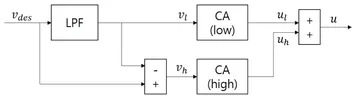
A control design strategy is proposed for the variable span and sweep morphing wing aircraft considering the morphing parameters as control effectors, which makes the system non-affine in control. The system is differentiated to obtain an increased-order system, which is affine in the derivative of the control input. The frequency-apportioned control allocation is used to cover the control input frequency gap between control surfaces and morphing system. An adaptation law is used to compensate for the allocation error caused by the time-varying control effectiveness matrix. Numerical simulation is performed to demonstrate the effectiveness of the proposed scheme for a morphing wing aircraft.
EUCASShttps://www.eucass.eu/doi/EUCASS2019-0163.pdfDOI: 10.13009/EUCASS2019-163https://doi.org/10.13009/EUCASS2019-163BibTeX@inproceedings{Lee2019, title = {Adaptive control allocation-based control design for non-affine morphing aircraft system}, author = {Hanna Lee and Jihoon Lee and Seong-hun Kim and Seungyun Jung and Youdan Kim}, year = {2019}, booktitle = {8th European Conference for Aeronautics and Space Sciences (EUCASS), Madrid, Spain, Jul. 2019}, doi = {10.13009/EUCASS2019-163}, } -
11th Asia-Pacific International Symposium on Aerospace Technology (APISAT), Gold Coast, Australia, Dec. 2019
Abstract
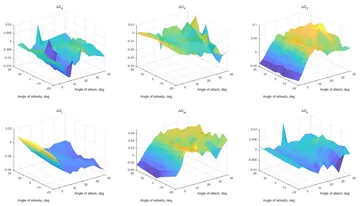
A cascade flight control system based on nonlinear dynamic inversion and time-scale separation is proposed for variable-span morphing aircraft. An asymmetric morphing aircraft model is developed by using an experimentally obtained damaged aircraft model. The aircraft is assumed to be able to adjust semi-span of the wing individually, and the resulting changes in the mass and aerodynamic properties due to the morphing are modeled. A set of inversion-based controllers is designed, where symmetric and asymmetric morphing variables are considered as additional control inputs. It is shown that the vehicle is capable of performing unusual maneuvers by using the conventional and morphing surfaces simultaneously. The effectiveness of the proposed scheme is demonstrated by numerical simulation.
Informithttps://search.informit.org/doi/10.3316/informit.942442757619423BibTeX@inproceedings{Lee2019, title = {Flight control of asymmetric variable-span morphing aircraft using nonlinear dynamic inversion}, author = {Jihoon Lee and Seungyun Jung and Seong-hun Kim and Hanna Lee and Youdan Kim}, year = {2019}, booktitle = {11th Asia-Pacific International Symposium on Aerospace Technology (APISAT), Gold Coast, Australia, Dec. 2019}, } -
16th European Control Conference (ECC), Limassol, Cyprus, Jun. 2018 · 9 citations
Abstract
In this study, a sliding mode controller is designed for a longitudinal dynamic model of a span and sweep-varying morphing unmanned aerial vehicle. Changes in aerodynamic and dynamic characteristics of the morphing wing aircraft model are investigated. Controller is designed based on an input-output linearization scheme to accomplish regulation and command tracking of airspeed and altitude. Numerical simulation is performed, and the results show that nominal tracking performance of the proposed controller is maintained even in the presence of the morphing wing configuration changes.
IEEE Xplorehttps://ieeexplore.ieee.org/document/8550259/DOI: 10.23919/ECC.2018.8550259https://doi.org/10.23919/ECC.2018.8550259BibTeX@inproceedings{Lee2018, title = {Sliding mode control design for a multidimensional morphing UAV}, author = {Jihoon Lee and Seong-hun Kim and Seungyun Jung and Hanna Lee and Youdan Kim}, year = {2018}, booktitle = {16th European Control Conference (ECC), Limassol, Cyprus, Jun. 2018}, doi = {10.23919/ECC.2018.8550259}, } -
10th Asia-Pacific International Symposium on Aerospace Technology (APISAT), Chengdu, China, Oct. 2018
Abstract
A control design strategy is proposed based on control allocation for the longitudinal motion of aircraft with variable-span and variable-sweep morphing wing. A morphing aircraft can change its shape during the flight, which allows the morphing aircraft to carry out various missions efficiently. Morphing parameters can be considered as control inputs, and therefore the system has redundant control inputs. The dynamics of morphing aircraft is transformed into a state-dependent coefficient form and regarded as an over-actuated system by augmenting control input with morphing parameters. Control allocation is used to distribute the generated control input adequately. Control allocation solves the optimization problem to minimize the displacement of control input, which is designed separately with the controller. Numerical simulations are performed to demonstrate the effectiveness of the proposed controller.
Author PDFhttps://jihoonlee91.github.io/papers/pdfs/2018-frequency-apportioned-control-allocation.pdfBibTeX@inproceedings{Lee2018, title = {Control Design for Morphing Aircraft Based on Frequency-Apportioned Control Allocation}, author = {Hanna Lee and Jihoon Lee and Seong-hun Kim and Seungyun Jung and Youdan Kim}, year = {2018}, booktitle = {10th Asia-Pacific International Symposium on Aerospace Technology (APISAT), Chengdu, China, Oct. 2018}, } -
31st Congress of the International Council of the Aeronautical Sciences (ICAS), Belo Horizonte, Brazil, Sep. 2018
Abstract
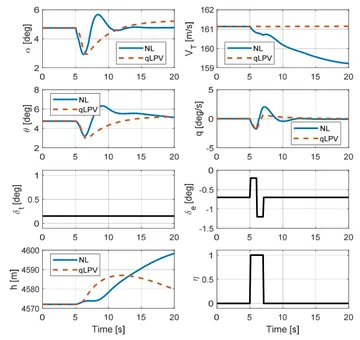
A near-optimal gain-scheduling strategy for the morphing aircraft flight control design is proposed. Nonlinear parameter-dependent dynamics of the morphing aircraft is transformed into a quasi-linear parameter-varying form. Assuming that the morphing parameters are determined in an outer-loop to meet system requirements, an inner-loop controller is designed by optimal control scheme. An algebraic Riccati equation using the parameter-dependent coefficient matrices is solved to design a near-optimal controller. Numerical simulation is performed to demonstrate the effectiveness of the proposed scheme.
ICAS Archivehttps://icas.org/ICAS_ARCHIVE/ICAS2018/data/papers/ICAS2018_0218_paper.pdfBibTeX@inproceedings{Lee2018, title = {Quasi-LPV Modeling and Parameter-dependent Optimal Control of Morphing Wing Aircraft}, author = {Jihoon Lee and Youdan Kim}, year = {2018}, booktitle = {31st Congress of the International Council of the Aeronautical Sciences (ICAS), Belo Horizonte, Brazil, Sep. 2018}, } -
7th European Conference for Aeronautics and Space Sciences (EUCASS), Milan, Italy, Jul. 2017
Abstract
Morphing aircraft is an aircraft that can change its configuration during the flight. Aircraft morphing technology is one of the methods that may improve the performance of the aircraft for various flight conditions. In this study, nonlinear control augmentation system for the morphing aircraft is proposed using nonlinear dynamic inversion based on neural network. Two-layer feed-forward neural networks are used to obtain longitudinal and lateral inverse maps which convert desired aerodynamic moments into actual control commands. Numerical simulation is performed for two maneuvers to demonstrate the effectiveness of the proposed scheme.
EUCASShttps://www.eucass.eu/doi/EUCASS2017-195.pdfDOI: 10.13009/eucass2017-195https://doi.org/10.13009/eucass2017-195BibTeX@inproceedings{Lee2017, title = {Neural network-based nonlinear dynamic inversion control of variable-span morphing aircraft}, author = {Jihoon Lee and Youdan Kim}, year = {2017}, booktitle = {7th European Conference for Aeronautics and Space Sciences (EUCASS), Milan, Italy, Jul. 2017}, doi = {10.13009/eucass2017-195}, } -
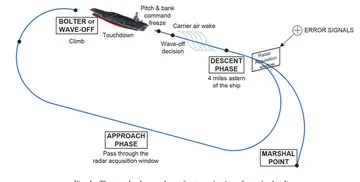
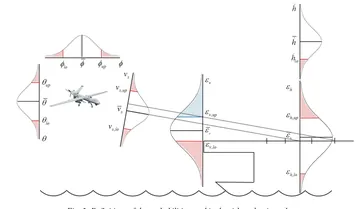
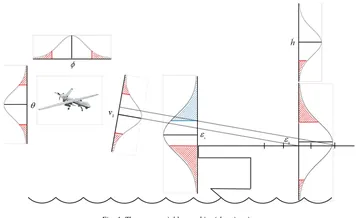
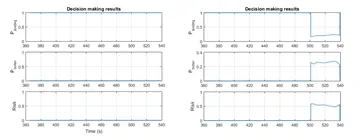
13. Stochastic Risk Evaluation Scheme for Wave-off Decision Making in Automatic Aircraft Carrier Landing7th Asia-Pacific International Symposium on Aerospace Technology (APISAT), Cairns, Australia, Nov. 2015
Abstract
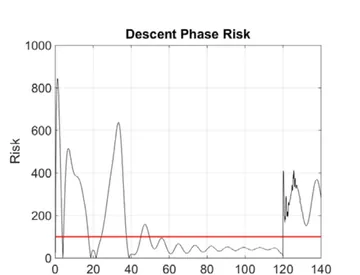
One of the greatest challenges for the air operations of fully automated aircraft carrier is to design an autonomous decision making system. In this paper, a probability-based risk evaluation scheme is proposed to make a wave-off, which is equivalent to go-around in ground landing, and the wave-off decision plays an important role in the terminal portion of landing. By the proposed risk evaluation scheme, the most probable consequence of the landing attempt can be forecasted. The risk evaluation scheme introduces six variables which are related to a glide path error, and they are assumed to follow the Gaussian probability distribution. The Monte Carlo simulation results with X-Plane flight simulator show that there exists a significant positive correlation between the estimated probabilities and the actual occurrence rate.
Author PDFhttps://jihoonlee91.github.io/papers/pdfs/2015-stochastic-risk-wave-off-decision.pdfBibTeX@inproceedings{Lee2015, title = {Stochastic Risk Evaluation Scheme for Wave-off Decision Making in Automatic Aircraft Carrier Landing}, author = {Jihoon Lee and Seokwon Lee and Somang Lee and Youdan Kim and Jungha Park and Seungkeun Kim and Jinyoung Suk}, year = {2015}, booktitle = {7th Asia-Pacific International Symposium on Aerospace Technology (APISAT), Cairns, Australia, Nov. 2015}, } -
7th Asia-Pacific International Symposium on Aerospace Technology (APISAT), Cairns, Australia, Nov. 2015
Abstract
Landing on an aircraft carrier is one of the most challenging issues for Unmanned Aerial Vehicles (UAVs) because position and velocity of the landing site change as the aircraft carrier continuously moves on the sea. In addition, uncertain parameters such as winds and heights of the waves make the automatic landing/take-off problem more difficult. This study proposes an Automatic Carrier Landing System (ACLS) for UAVs including decision making process as well as guidance and control. The problem considered in this study is composed of three phases: take-off, approach, and landing. Suitable guidance and control laws are designed for each phase. Decision making logic is also developed based on the stochastic risk evaluation scheme. Numerical simulation results demonstrate the performance of the proposed decision making logic and guidance and control laws.
Author PDFhttps://jihoonlee91.github.io/papers/pdfs/2015-autonomous-uav-takeoff-landing-carrier.pdfBibTeX@inproceedings{Lee2015, title = {A Study on Autonomous UAV Take-off and Landing on a Carrier}, author = {Somang Lee and Jihoon Lee and Seokwon Lee and Youdan Kim and Jinyoung Suk and Seungkeun Kim}, year = {2015}, booktitle = {7th Asia-Pacific International Symposium on Aerospace Technology (APISAT), Cairns, Australia, Nov. 2015}, }
Domestic Conference Papers (20)
-
1. Development of an Indoor Path Planning System for Search and Rescue Operations of the Firefighters2021 IPNT Conference (IPNT 2021), Gangneung, Korea, Nov. 2021 · in Korean
Abstract
This paper considers a path-planning system for rescuing multiple victims in indoor disaster environments. Path-planning problems at fire scenes must account for requirements that differ from those of general path-planning problems. Path length is important for rapid rescue and evacuation, and the indoor environment may change rapidly because of fire. This study develops a path-planning system that considers these factors and includes map generation, map preprocessing, graph construction and reduction, visit-order determination, and path generation and postprocessing. In the map-generation stage, the building interior is converted into a grid representation, and hazardous regions are removed during map preprocessing. During graph construction and reduction, the information represented in the grid is transformed into a weighted graph, with each edge weighted by the length of the path connecting two points. The A*, RRT, RRT*, and PRM-A* algorithms are considered for path planning. In the visit-order determination stage, the order is selected to minimize the length of the route that visits all victims and evacuates them. Finally, paths are generated on the map according to the selected order and postprocessed to improve their characteristics. Numerical simulations are performed to verify the performance of the proposed path-planning system.
IPNT Proceedingshttps://ipnt.or.kr/2021IPNT/file/C5-4.pdfBibTeX@inproceedings{Park2021, title = {Development of an Indoor Path Planning System for Search and Rescue Operations of the Firefighters}, author = {Heein Park and Jihoon Lee and Youdan Kim and Chan Gook Park and Jae Hong Lee}, year = {2021}, booktitle = {2021 IPNT Conference (IPNT 2021), Gangneung, Korea, Nov. 2021}, note = {Original Korean title: 소방관의 수색 및 구조작업을 위한 실내 경로계획 시스템 개발}, } -
2021 KSAS Fall Conference (KSAS 2021F), Jeju, Korea, Nov. 2021 · in Korean
Abstract
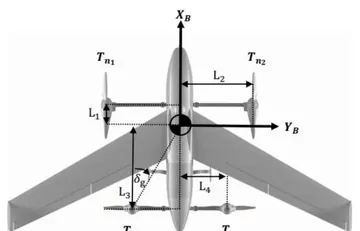
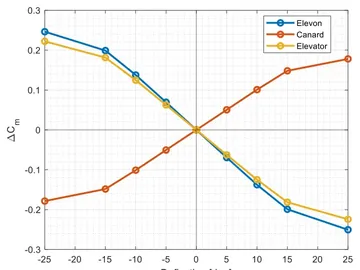
Current ground-based explosive ordnance clearance methods are inefficient in terms of time and cost, increasing the need for wide-area detection systems using unmanned aerial vehicles. Detecting buried explosives with UAV-mounted sensors constrains UAV maneuvers according to sensor characteristics. To perform the mission under these constraints, additional control surfaces and a flight-control system that accounts for them are required to improve control authority. This study considers additional control effectors to improve the longitudinal flight performance of the existing ARGOS-1 vehicle and compares them with the baseline configuration. Specifically, it considers using the forward propulsors, which are inactive in fixed-wing mode, installing canards at the front of the vehicle, and installing an elevator at the rear; trim analysis is used to evaluate the resulting changes in control authority.
DBpiahttps://www.dbpia.co.kr/journal/articleDetail?nodeId=NODE11031427BibTeX@inproceedings{Lee2021, title = {Control Surface Modeling and Control Authority Analysis for Longitudinal Motion of Control-Configured Vehicle}, author = {Jihoon Lee and Hyeonggwan Kang and Sangmin Lee and Youdan Kim and Jinyoung Suk and Seungkeun Kim}, year = {2021}, booktitle = {2021 KSAS Fall Conference (KSAS 2021F), Jeju, Korea, Nov. 2021}, note = {Original Korean title: 능동제어 비행체의 종방향 운동을 위한 조종면 모델링 및 조종력 분석}, } -
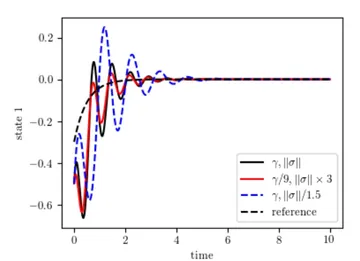
2020 KSAS Spring Conference (KSAS 2020S), Goseong, Korea, Jul. 2020 · in KoreanDBpia
https://www.dbpia.co.kr/journal/articleDetail?nodeId=NODE10442093BibTeX@inproceedings{Lee2020, title = {Maneuvering Target Tracking with Anomalous Measurement Errors of Laser Range Finder}, author = {Jihoon Lee and Suwon Lee and Youngjun Lee and Youdan Kim and Young-jun Heo and Tae-dong Yoon}, year = {2020}, booktitle = {2020 KSAS Spring Conference (KSAS 2020S), Goseong, Korea, Jul. 2020}, note = {Original Korean title: 레이저 거리측정기의 변칙적 측정오차를 고려한 기동표적 추적}, } -
2019 KSAS Fall Conference (KSAS 2019F), Jeju, Korea, Nov. 2019 · in KoreanDBpia
https://www.dbpia.co.kr/journal/articleDetail?nodeId=NODE09317850BibTeX@inproceedings{Lee2019, title = {Modeling and Simulation of Asymmetric Variable-Span Morphing Aircraft}, author = {Jihoon Lee and Seungyun Jung and Seong-hun Kim and Hanna Lee and Youdan Kim}, year = {2019}, booktitle = {2019 KSAS Fall Conference (KSAS 2019F), Jeju, Korea, Nov. 2019}, note = {Original Korean title: 비대칭 가변스팬 모핑 항공기의 모델링 및 시뮬레이션}, } -
2019 KSAS Fall Conference (KSAS 2019F), Jeju, Korea, Nov. 2019 · in KoreanDBpia
https://www.dbpia.co.kr/journal/articleDetail?nodeId=NODE09317891BibTeX@inproceedings{Lee2019, title = {Partially Model-Free Control Design for Morphing Aircraft using Adaptive Dynamic Programming}, author = {Hanna Lee and Seong-hun Kim and Jihoon Lee and Seungyun Jung and Youdan Kim}, year = {2019}, booktitle = {2019 KSAS Fall Conference (KSAS 2019F), Jeju, Korea, Nov. 2019}, note = {Original Korean title: 적응 동적 프로그래밍을 이용한 모핑 항공기의 부분 Model-Free 제어기 설계}, } -
2019 KSAS Spring Conference (KSAS 2019S), Buan, Korea, Apr. 2019 · in KoreanDBpia
https://www.dbpia.co.kr/journal/articleDetail?nodeId=NODE08753032BibTeX@inproceedings{Lee2019, title = {Morphing Aircraft Inverse Dynamics Learning and Control Based on Gaussian Processes}, author = {Hanna Lee and Seong-hun Kim and Jihoon Lee and Youdan Kim}, year = {2019}, booktitle = {2019 KSAS Spring Conference (KSAS 2019S), Buan, Korea, Apr. 2019}, note = {Original Korean title: 가우시안 프로세스를 이용한 모핑 항공기 역동역학 모델 학습 및 제어}, } -
2018 SASE Fall Conference (SASE 2018F), Gyeongju, Korea, Nov. 2018 · in Korean
Abstract
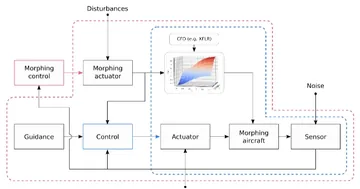
This study proposes a hierarchical flight-control system for morphing aircraft. A fixed-wing aircraft capable of actively changing its wing configuration in flight is referred to as a morphing aircraft. By adapting its configuration to the flight regime and mission, a morphing aircraft can optimize the required flight performance. However, the additional actuation mechanisms required for morphing may increase aircraft weight or reduce structural stiffness. Moreover, if changes in flight characteristics caused by configuration changes are not properly considered in flight-control design, performance and stability may be degraded. This study aims to design flight-control laws that guarantee performance during configuration changes and to develop a flight-control system that actively exploits morphing.
SASE Proceedingshttps://sase.or.kr/Upload/Session/21/P%EA%B5%90%EB%A5%98%ED%9A%8C-1.pdfBibTeX@inproceedings{Lee2018, title = {Hierarchical Flight Control System for Morphing Aircraft}, author = {Jihoon Lee and Seungyun Jung and Seong-hun Kim and Hanna Lee and Youdan Kim and Jaesung Bae}, year = {2018}, booktitle = {2018 SASE Fall Conference (SASE 2018F), Gyeongju, Korea, Nov. 2018}, note = {Original Korean title: 모핑 항공기를 위한 계층적 비행제어시스템}, } -
2018 KSAS Fall Conference (KSAS 2018F), Jeju, Korea, Nov. 2018 · in KoreanDBpia
https://www.dbpia.co.kr/journal/articleDetail?nodeId=NODE07619663BibTeX@inproceedings{Lee2018, title = {Robust Closed-loop Control Allocation for Morphing Aircraft}, author = {Hanna Lee and Jihoon Lee and Yongjun Seo and Youdan Kim}, year = {2018}, booktitle = {2018 KSAS Fall Conference (KSAS 2018F), Jeju, Korea, Nov. 2018}, note = {Original Korean title: 모핑 항공기를 위한 강건 폐루프 조종력 할당 기법}, } -
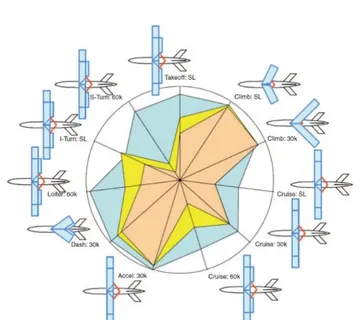
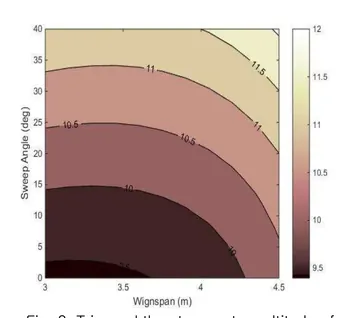
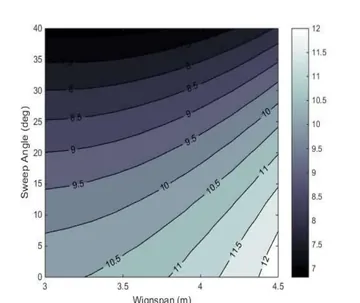
2018 KSAS Fall Conference (KSAS 2018F), Jeju, Korea, Nov. 2018 · in KoreanDBpia
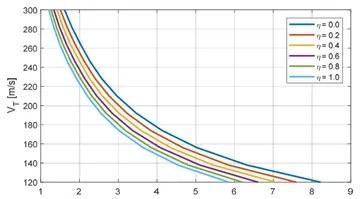
https://www.dbpia.co.kr/journal/articleDetail?nodeId=NODE07619662BibTeX@inproceedings{Lee2018, title = {Performance Map of Morphing Aircraft for Hierarchical Control}, author = {Jihoon Lee and Seong-hun Kim and Seungyun Jung and Hanna Lee and Youdan Kim}, year = {2018}, booktitle = {2018 KSAS Fall Conference (KSAS 2018F), Jeju, Korea, Nov. 2018}, note = {Original Korean title: 계층적 제어를 위한 모핑 항공기의 성능 지도}, } -
2018 KSAS Spring Conference (KSAS 2018S), Goseong, Korea, Apr. 2018 · in KoreanDBpia
https://www.dbpia.co.kr/journal/articleDetail?nodeId=NODE07525791BibTeX@inproceedings{Lee2018, title = {Control Design of Variable Span-Sweep Morphing Wing UAV Using Control Allocation}, author = {Hanna Lee and Jihoon Lee and Seong-hun Kim and Seungyun Jung and Youdan Kim}, year = {2018}, booktitle = {2018 KSAS Spring Conference (KSAS 2018S), Goseong, Korea, Apr. 2018}, note = {Original Korean title: 조종력 할당기법을 이용한 가변 스팬-스윕 모핑 무인기 제어기 설계}, } -
2017 KSAS Fall Conference (KSAS 2017F), Jeju, Korea, Nov. 2017 · in KoreanDBpia
https://www.dbpia.co.kr/journal/articleDetail?nodeId=NODE07366907BibTeX@inproceedings{Lee2017, title = {Quasi-Linear Parameter-Varying Modeling of Variable-Span Morphing Aircraft Longitudinal Motion}, author = {Jihoon Lee and Seungyun Jung and Seong-hun Kim and Hanna Lee and Youdan Kim}, year = {2017}, booktitle = {2017 KSAS Fall Conference (KSAS 2017F), Jeju, Korea, Nov. 2017}, note = {Original Korean title: 가변스팬 모핑 항공기 종방향 운동의 준선형 파라미터 변이 모델링}, } -
2017 KSAS Spring Conference (KSAS 2017S), Samcheok, Korea, Apr. 2017 · in KoreanDBpia
https://www.dbpia.co.kr/journal/articleDetail?nodeId=NODE07188661BibTeX@inproceedings{Lee2017, title = {Flight Control of a Variable Span Morphing Wing UAV}, author = {Jihoon Lee and Seong-hun Kim and Seungyun Jung and Jaesung Bae and Seungkeun Kim and Youdan Kim}, year = {2017}, booktitle = {2017 KSAS Spring Conference (KSAS 2017S), Samcheok, Korea, Apr. 2017}, note = {Original Korean title: 가변스팬 모핑날개 무인기 비행제어 설계}, } -
2017 KSAS Spring Conference (KSAS 2017S), Samcheok, Korea, Apr. 2017 · in KoreanDBpia
https://www.dbpia.co.kr/journal/articleDetail?nodeId=NODE07188662BibTeX@inproceedings{Jung2017, title = {Flight Control of a Variable Span Morphing Aircraft during Transition Phase}, author = {Seungyun Jung and Seong-hun Kim and Jihoon Lee and Jaesung Bae and Seungkeun Kim and Youdan Kim}, year = {2017}, booktitle = {2017 KSAS Spring Conference (KSAS 2017S), Samcheok, Korea, Apr. 2017}, note = {Original Korean title: 가변스팬 모핑항공기의 형상변화 천이구간 비행제어}, } -
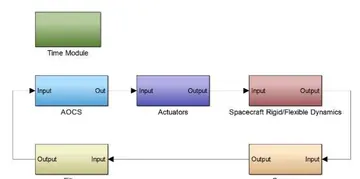
2017 KSAS Spring Conference (KSAS 2017S), Samcheok, Korea, Apr. 2017 · in KoreanDBpia
https://www.dbpia.co.kr/journal/articleDetail?nodeId=NODE07188715BibTeX@inproceedings{Kim2017, title = {Conceptual Study of an AOCS Simulator and Three Dimensional Visualization Environment for Lunar Orbiter}, author = {Byunghoon Kim and Suwon Lee and Jaeho Lee and Somang Lee and Jihoon Lee and Namhoon Cho and Youdan Kim and Gwanghyeok Ju}, year = {2017}, booktitle = {2017 KSAS Spring Conference (KSAS 2017S), Samcheok, Korea, Apr. 2017}, note = {Original Korean title: 달 궤도선 자세제어계 시뮬레이터 개념연구 및 3차원 가시화장치 구축}, } -
2017 KSAS Spring Conference (KSAS 2017S), Samcheok, Korea, Apr. 2017 · in KoreanDBpia
https://www.dbpia.co.kr/journal/articleDetail?nodeId=NODE07188704BibTeX@inproceedings{Lee2017, title = {Grid Modeling of Solar Radiation Pressure and Effect on Earth-Lunar Transfer Trajectory}, author = {Suwon Lee and Jihoon Lee and Byunghoon Kim and Youdan Kim and Gwanghyeok Ju}, year = {2017}, booktitle = {2017 KSAS Spring Conference (KSAS 2017S), Samcheok, Korea, Apr. 2017}, note = {Original Korean title: 격자 형태의 태양복사압 모델링 및 지구-달 천이궤적에 미치는 영향 분석}, } -
2017 KSAS Fall Conference (KSAS 2017F), Jeju, Korea, Nov. 2017 · in KoreanDBpia
https://www.dbpia.co.kr/journal/articleDetail?nodeId=NODE07366913BibTeX@inproceedings{Kim2017, title = {Spectral Analysis of Model Reference Adaptive Control System}, author = {Seong-hun Kim and Jihoon Lee and Seungyun Jung and Youdan Kim}, year = {2017}, booktitle = {2017 KSAS Fall Conference (KSAS 2017F), Jeju, Korea, Nov. 2017}, note = {Original Korean title: 모델추종 적응제어 시스템의 천이구간 스펙트럼 분석}, } -
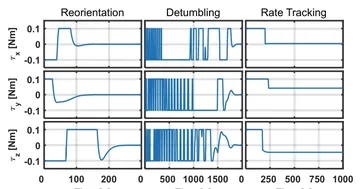
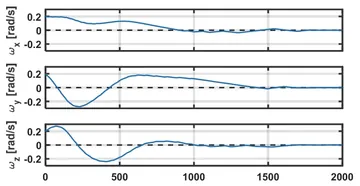
2016 KSAS Spring Conference (KSAS 2016S), Goseong, Korea, Apr. 2016 · in Korean
Abstract
Attitude control is essential for spacecraft mission. In this study, linear model following nonlinear adaptive controller is expanded so that it could be applied to spacecraft attitude maneuvers. Numerical simulations under actuator saturation demonstrate that the designed controller meets performance objectives in the presence of actuator saturation and uncertainties.
DBpiahttps://www.dbpia.co.kr/journal/articleDetail?nodeId=NODE07068013BibTeX@inproceedings{Lee2016, title = {Spacecraft Attitude Maneuver Control Using Linear Model Following Nonlinear Adaptive Controller}, author = {Jihoon Lee and Suwon Lee and Byunghoon Kim and Youdan Kim and Gwanghyeok Ju}, year = {2016}, booktitle = {2016 KSAS Spring Conference (KSAS 2016S), Goseong, Korea, Apr. 2016}, note = {Original Korean title: 선형모델 추종 비선형 적응제어기를 이용한 인공위성 자세기동}, } -
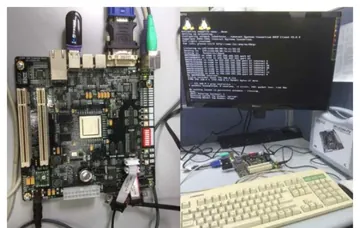
2016 KSAS Spring Conference (KSAS 2016S), Goseong, Korea, Apr. 2016 · in Korean
Abstract
The purposes of this study are to develop guidance, navigation, and control algorithm for the experimental lunar orbiter, to develop the source code for the developed algorithm, and to verify the developed source code using the embedded computer. In the development of the algorithm, the optimal trajectory of Earth-Moon transfer is designed using GMAT, and attitude controller for satellite is also designed. Developing the source code, MATLAB/Simulink based lunar orbiter simulator is developed. To verify the developed source code applying autocode generation, Processor-In-the-Loop-Simulation (PILS) system is supposed to be built up using LEON 4 processor.
DBpiahttps://www.dbpia.co.kr/journal/articleDetail?nodeId=NODE07068032BibTeX@inproceedings{Kim2016, title = {A Primary Study on the Control System for Lunar Orbiter Using Autocode Generation}, author = {Byunghoon Kim and Namhoon Cho and Jaeho Lee and Somang Lee and Jihoon Lee and Suwon Lee and Youdan Kim and Gwanghyeok Ju}, year = {2016}, booktitle = {2016 KSAS Spring Conference (KSAS 2016S), Goseong, Korea, Apr. 2016}, note = {Original Korean title: 자동코드생성을 이용한 달 궤도선 제어 기초연구}, } -
3rd Aviation-Specialized University Conference, Seoul, Korea, Feb. 2016 · in Korean
Abstract
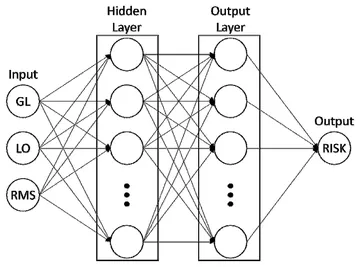
Automatic aircraft carrier landing on an aircraft carrier has many risk factors, and it is important to make a proper wave-off decision by evaluating the risk. While a landing signal officer generally takes responsibility for the decision, full automation of carrier landing requires a appropriate risk evaluation scheme. In this paper, two position error-based risk evaluation schemes considering landing environment are proposed using artificial neural network. The artificial neural network takes vertical/horizontal glide path error or corresponding scale factor of ellipse as inputs in addition to root mean square value of distance to glide path, and takes reward or penalty according to the outcome of the landing attempt: successful landing, bolter and crash. Learning data for the network are obtained through Monte Carlo simulation.
Author PDFhttps://jihoonlee91.github.io/papers/pdfs/2016-nn-carrier-landing-risk-assessment-ko.pdfBibTeX@inproceedings{Lee2016, title = {Risk Evaluation Scheme in Automatic Aircraft Carrier Landing Using Artificial Neural Network}, author = {Jihoon Lee and Somang Lee and Seokwon Lee and Donghae Kim and Youdan Kim}, year = {2016}, booktitle = {3rd Aviation-Specialized University Conference, Seoul, Korea, Feb. 2016}, note = {Original Korean title: 인공신경망을 이용한 함상 자동착륙 상황에서의 위험도 평가 기법}, } -
2015 KSAS Spring Conference (KSAS 2015S), Jeongseon, Korea, Apr. 2015 · in Korean
Abstract
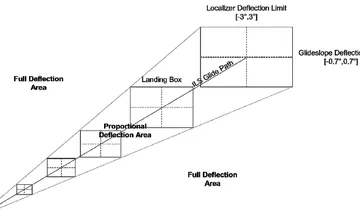
Aircraft carrier environment requires a self-determining decision making (DM) process associated with carrier landing for the effective operation of UAVs. In this paper, a DM process for UAV automatic carrier landing (ACL) is proposed, and an ACL sequence for UAVs is established based on that of manned aircraft. The sequence consists of three different phases; approach, descent and touchdown phase. During the descent phase, the UAV takes wave-off (WO) maneuver when specific condition on aircraft position error is not satisfied. Bolter maneuver is executed considering whether or not the arresting hook of the landing aircraft engaged one of four deck pendants. Transition conditions between each phases are studied and numerical simulation is performed to demonstrate the performance of the proposed DM structure.
DBpiahttps://www.dbpia.co.kr/journal/articleDetail?nodeId=NODE06591215BibTeX@inproceedings{Lee2015, title = {A Decision Making Technique for UAV Automatic Carrier Landing System}, author = {Jihoon Lee and Seokwon Lee and Jungha Park and Youdan Kim and Seungkeun Kim and Jinyoung Suk}, year = {2015}, booktitle = {2015 KSAS Spring Conference (KSAS 2015S), Jeongseon, Korea, Apr. 2015}, note = {Original Korean title: 무인기 자동착함 시스템을 위한 의사결정 기법}, }
Ph.D. Dissertation (1)
-
Ph.D. Dissertation, Seoul National University (Advisor: Prof. Youdan Kim), 2023
Abstract
In this dissertation, a novel framework for flight control of a morphing unmanned aerial vehicle (UAV) is proposed. The proposed method uses asymmetric span morphing for lateral-directional motion control considering the dynamic characteristics of the morphing actuators while exploiting the advantages of symmetric span morphing for longitudinal flight performance enhancement. The proposed control system is self-scheduled based on linear parameter-varying (LPV) methods, which guarantees stability and performance for the variations of the morphing configuration and the flight condition. Therefore, the morphing UAV is allowed to swiftly metamorphose into the optimal configuration to maximize the system-level benefit according to the maneuvering command and the flight condition. First, a high-fidelity nonlinear model of an asymmetric variable-span morphing UAV is obtained from the NASA generic transport model. The impacts of morphing on the center of mass, inertia matrix, and aerodynamic coefficients are modeled based on the asymmetrically damaged wing model. The span variation ratios of the left and right wings are decomposed into symmetric and asymmetric morphing parameters, which are considered as the scheduling parameter and the control input, respectively. The nonlinear model is decoupled and linearized to obtain point-wise linear time-invariant (LTI) models for the longitudinal and lateral-directional motions throughout the grid points over the entire rectangularized scheduling parameter domain. The LPV model of the morphing UAV is derived for the longitudinal and lateral-directional motions by associating the family of LTI models through interpolation. Second, the longitudinal and lateral-directional control augmentation systems are designed based on LPV methods to track the normal acceleration command and the angle of sideslip and the roll rate commands, respectively. The inherent dynamic characteristics of the morphing actuator, such as low bandwidth, are considered in the control design procedure through a frequency-dependent weighting filter. The span morphing strategy to assist the intended maneuver is studied considering the impacts of morphing on various aspects. Numerical simulations are performed to demonstrate the effectiveness of the proposed control scheme for pushover-pullup maneuver and high-g turn. Finally, the longitudinal and lateral-directional autopilots are designed based on LPV methods to track the airspeed and altitude commands and the angle of sideslip and roll angle commands, respectively. A nonlinear guidance law is coupled with the autopilots to enable three-dimensional trajectory tracking. Numerical simulation results for the trajectory-tracking flight show that the proposed controller shows satisfactory performance, while the closed-loop system using the conventional gain-scheduled controller may lose stability when the scheduling parameter varies rapidly or widely.
SNU Repositoryhttps://dcollection.snu.ac.kr/common/orgView/000000176713BibTeX@phdthesis{Lee2023, title = {Self-Scheduled Parameter-Varying Control of Asymmetric Variable-Span Morphing Unmanned Aerial Vehicle}, author = {Jihoon Lee}, year = {2023}, school = {Ph.D. Dissertation, Seoul National University (Advisor: Prof. Youdan Kim)}, }