Multi-level indoor path planning and clearance-based path optimization for search and rescue operations
IEEE Access, Vol. 11, pp. 40930-40943, 2023 · 19 citations

Figures and captions reproduced from the paper (© the authors and original publisher).
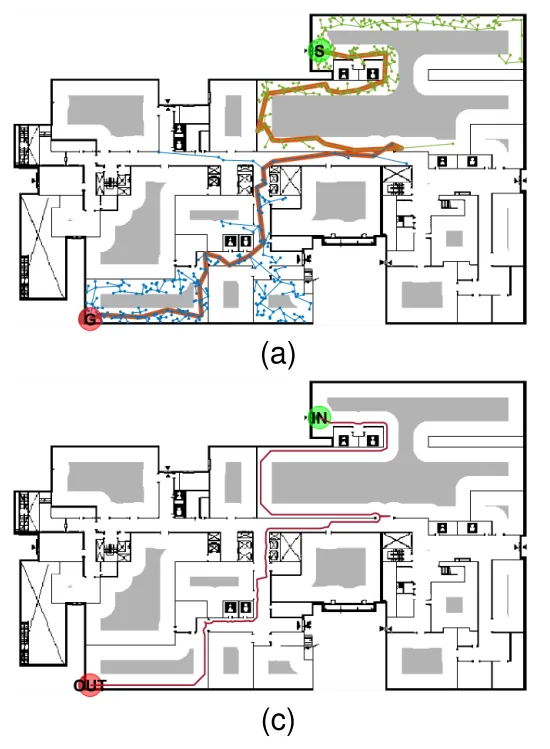
In this study, a multi-level path planning system is proposed for indoor search and rescue operations. Requirements for the path planning system are derived based on the operational concept of the integrated indoor navigation system. Different aspects of various path planning algorithms are assessed, and their suitability to search and rescue operations in structured indoor environments is investigated. A five-step path planning system is proposed, which consists of map pre-processing, segment path planning, graph processing, route optimization, and path post-processing. The proposed method addresses a multi-goal path planning problem in a multi-story building in a computationally efficient way by adopting a graph-based approach while satisfying such requirements as clearance conditions in the pre- and post-processing steps. Furthermore, a multi-query approach is adopted to exploit the response time and earn flexibility with respect to environmental changes. The effectiveness of the proposed path planning system is demonstrated through numerical simulations. The proposed multi-level path planning system successfully adapts to complex indoor environments, enabling more effective navigation for search and rescue operations. Additionally, the system exhibits a high degree of flexibility in response to environmental changes, ensuring that the path planning remains robust and reliable even in dynamically changing situations.
https://ieeexplore.ieee.org/document/10107604/DOI: 10.1109/ACCESS.2023.3269981https://doi.org/10.1109/ACCESS.2023.3269981BibTeX@article{Lee2023,
title = {Multi-level indoor path planning and clearance-based path optimization for search and rescue operations},
author = {Jihoon Lee and Heein Park and Youdan Kim and Chan Gook Park and Jae Hong Lee},
year = {2023},
journal = {IEEE Access},
volume = {11},
pages = {40930-40943},
doi = {10.1109/ACCESS.2023.3269981},
}