Development of an Indoor Path Planning System for Search and Rescue Operations of the Firefighters
Published in Korean (English title shown)
2021 IPNT Conference (IPNT 2021), Gangneung, Korea, Nov. 2021
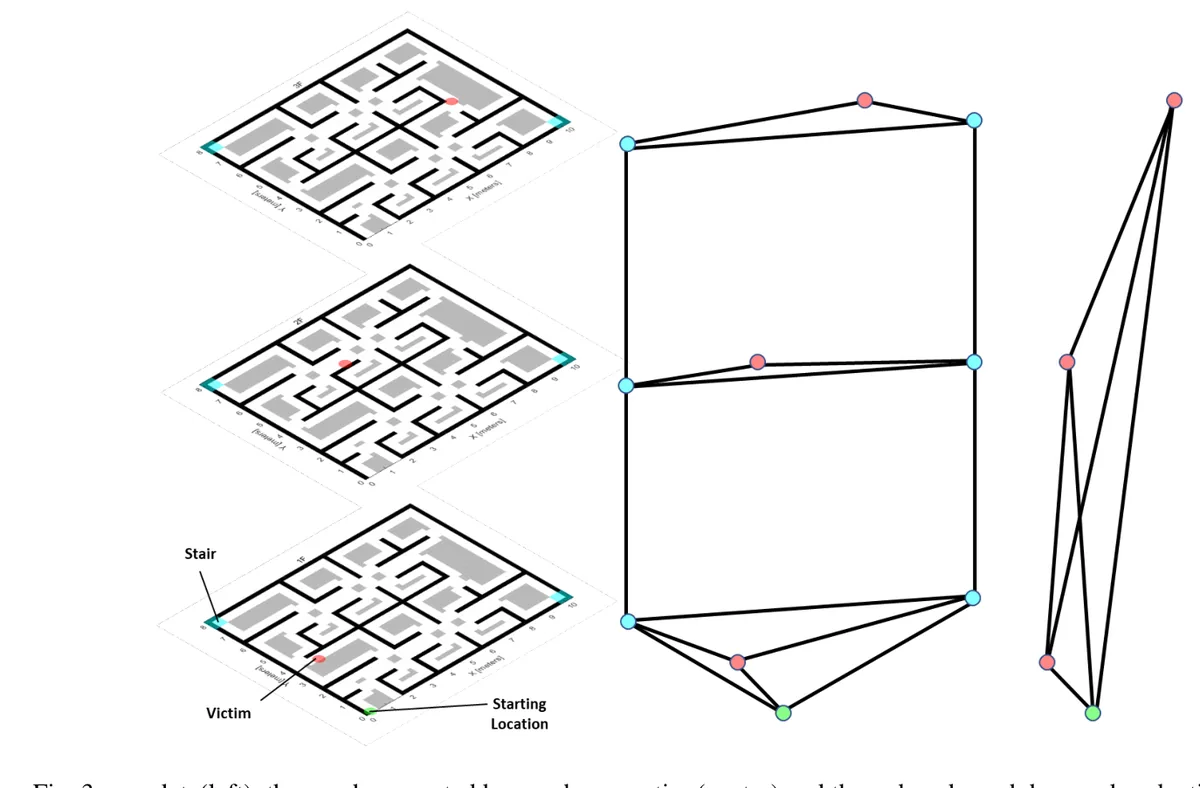
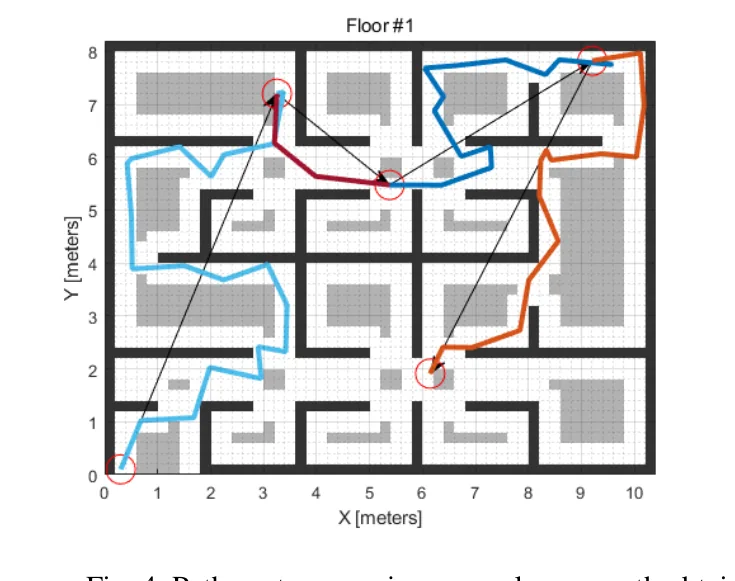
Figures and captions reproduced from the paper (© the authors and original publisher).
This paper considers a path-planning system for rescuing multiple victims in indoor disaster environments. Path-planning problems at fire scenes must account for requirements that differ from those of general path-planning problems. Path length is important for rapid rescue and evacuation, and the indoor environment may change rapidly because of fire. This study develops a path-planning system that considers these factors and includes map generation, map preprocessing, graph construction and reduction, visit-order determination, and path generation and postprocessing. In the map-generation stage, the building interior is converted into a grid representation, and hazardous regions are removed during map preprocessing. During graph construction and reduction, the information represented in the grid is transformed into a weighted graph, with each edge weighted by the length of the path connecting two points. The A*, RRT, RRT*, and PRM-A* algorithms are considered for path planning. In the visit-order determination stage, the order is selected to minimize the length of the route that visits all victims and evacuates them. Finally, paths are generated on the map according to the selected order and postprocessed to improve their characteristics. Numerical simulations are performed to verify the performance of the proposed path-planning system.
https://ipnt.or.kr/2021IPNT/file/C5-4.pdfBibTeX@inproceedings{Park2021,
title = {Development of an Indoor Path Planning System for Search and Rescue Operations of the Firefighters},
author = {Heein Park and Jihoon Lee and Youdan Kim and Chan Gook Park and Jae Hong Lee},
year = {2021},
booktitle = {2021 IPNT Conference (IPNT 2021), Gangneung, Korea, Nov. 2021},
note = {Original Korean title: 소방관의 수색 및 구조작업을 위한 실내 경로계획 시스템 개발},
}